
It’s all covered here
Acade, Spectrum, Amiga,
Genesis, Master System, C64.
All of Chase HQ,
in all it’s glory.
I've been wanting to discuss this game for a long time!
Chase HQ is, by far, my top choice for a desert island arcade machine, despite the fact that it can be completed in just 10 minutes with some skillful play.
The beginning
In the late 80s, Taito was at its peak, with notable releases such as Arkanoid, Bubble Bobble, Darius, Rastan, Rainbow Islands, and Operation Wolf.
Chase HQ, released in October 1988 and designed by Hiroyuki Sakou, was a standout title from this era. While it shares graphical similarities with Sega’s Outrun, it features enhancements like better perspective, hill presentation, and track continuity.
The game used Taito’s Z-System, which included dual Motorola 68000 graphics and Z80 sound processors, similar to the Sega Outrun board, allowing for advanced graphics and sprite scaling.
Chase HQ is often seen as a spiritual successor to Taito’s Full Throttle (or Top Speed), which inspired the turbo button and had similar graphics. Full Throttle was based on older hardware also used for Operation Thunderbolt. Notably, billboards in Full Throttle hint at Taito’s next game, influenced by a Miami Vice press image.
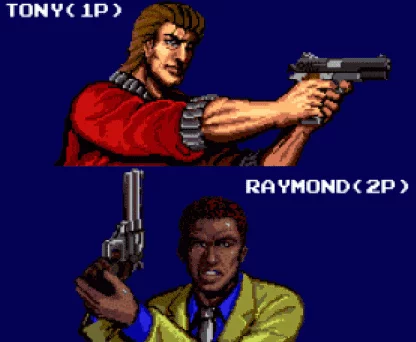
Instead of Crockett and Tubbs from Miami Vice, the elite officers of Chase HQ are Tony Gibson and Raymond Brody. Working in the special Chase Unit, their undercover vehicle and weapon of choice is a sleek Porsche 928, crucial for pursuing those fast European sports cars driven by criminals.
At Chase HQ, your mission is to track down lawbreakers in high-performance sports cars and ram them off the road once you’ve caught up. You have 60 seconds to navigate the course and locate the offender, followed by another 60 seconds to force them off the road. Utilize the 3 turbo boosts available to quickly close the gap if you stray off course, hit the criminal too hard, or misjudge your timing, and need to catch up.
Tony Gibson & Raymond Broady
20 pence to go
Inserting 20 pence into the slot gives you your first credit, which, if you’re experienced, could potentially carry you through to the end of the game, thanks to its generous difficulty curve.
Each mission is communicated to you by Nancy at Chase Headquarters, who provides details about the suspect you’re pursuing and their vehicle, starting with the Idaho Slasher in a white Lotus Esprit. While not explicitly named, the car’s British design makes its identity clear.
You receive a map showing a somewhat vague “Street lined with large buildings.” Brody offers some encouraging words, and then you’re off—gear lever in one hand, steering wheel in the other.
From this point on, you’ll experience an arcade thrill like no other, combining all those 80s cop chase scenes into a hands-on adventure. The graphics, music, engine sounds, and digitized speech create a rush of excitement as you race against the clock to catch your suspect. If you’re quick, you get extra time to force him off the road; if not, he escapes. The game remains a race against time, but now you have a mission: maneuver your car to cause maximum damage while maintaining speed. Watch for the “Criminals here” arrow, enjoy Brody’s enthusiasm, and fill the damage meter to the brink of explosion. Apprehend your suspect (maybe Robert De Niro) and read his rights (is that George Takei?). In this pixelated world, it’s a fun twist on policing, but let’s keep it light.
The Levels
Your mission is to chase down the criminals and stop them before time runs out. There are also dip switch settings to adjust certain aspects of the game, and you can configure the controls in the way that suits you best. Use the nitro for a brief boost of enhanced acceleration. Practicing will help you improve your skills in this game.
To start the game, insert a coin and then press the "start" button.
Give it your best shot!
Level 1
The headquarters will inform you which criminal to pursue. Ralph “the Ripper” from Idaho is fleeing towards the outskirts. The target vehicle is a white British sports car, a Lotus Esprit. The first level is particularly easy due to the wide roads, but that doesn’t mean it’s entirely simple: you’ll still need to downshift to steer better and avoid civilian cars during slippery turns. There’s also a fork in the road, so follow the direction indicated by the arrow; otherwise, you might take the wrong path and take longer to catch the fugitive. Use the turbo to briefly speed up and hit the fugitive more easily. The suspect will be arrested on suspicion of murder.

Level 2
The headquarters will inform you which criminal to pursue. Carlos, the armed robber from New York, has been spotted on the highway driving a yellow sports car, a Lamborghini Countach. The second level is relatively easy: a helicopter will indicate whether the fugitive has turned left or right at the fork in the road, so listen carefully to the pilot’s directions, who will say “left” or “right.” Be careful not to take the wrong road by mistake. The suspect will be arrested on charges of armed robbery and murder.

Level 3
The headquarters will inform you which criminal to pursue. A gang of drug dealers from Chicago is fleeing towards the outskirts. The target vehicle is a gray German sports car, a Porsche 911 Turbo Model 930. The third level is similar to the first, but a bit more challenging because the roads are narrower and there are more slalom turns. There’s another fork in the road, so follow the arrow that indicates the correct direction to take. The suspects will be arrested on charges of drug trafficking.

Level 4
The headquarters will inform you which criminal to pursue. The kidnapper from Los Angeles is speeding towards the suburbs in a two-seater blue car, a Ferrari 288 GTO. The fourth level is similar to the second, but more difficult due to narrow roads and winding curves, so it’s advisable to downshift frequently when necessary. Listen carefully to the pilot’s directions regarding which way to go at the fork in the road. The suspect will be arrested on charges of kidnapping.

Level 5
The headquarters will inform you which criminal to pursue. The Eastern Bloc spy from Washington is fleeing towards the suburbs. The target vehicle is unknown. The final level is similar to the second and fourth but highly challenging. Listen carefully to the brief instructions from the helicopter pilot before you reach the fork in the road. Once you’ve chosen the correct direction, proceed with maximum alertness and skill, and don’t let the fugitive’s frantic movement pressure you. The suspect will be arrested on charges of espionage and murder.

Congratulations on completing the game!
You will receive extra points if you finish it with only one coin.
Of course, no classic gaming experience is complete without a range of home conversions, and Chase HQ is well-represented in this regard. Despite this, I never had the opportunity to obtain any of these conversions during my youth. In those days, finding games involved painstakingly searching through magazine advertisements or physically visiting local stores, a process that made it challenging to keep up with every release. It wasn’t until I acquired a Sega Mega Drive that I discovered the ports, although, unfortunately, the Mega Drive version of this classic game was not released in Europe.
Among the most noteworthy adaptations are the 1989 Z80 versions produced by Ocean, which include programming by Jon O’Brien and graphics by Bill Harbison. These versions, available for MSX, ZX Spectrum, and Amstrad CPC, stand out for their animated titles, synthesized speech, and a well-crafted end-of-game sequence. They provide a significantly improved experience compared to the earlier Outrun conversions, showcasing the advances made in home gaming adaptations.
Portability
Spin-off
During this period, various spin-offs of the original game made their way to home consoles. Notably, Chase HQ Secret Police was released for the Game Boy Color in 2000, and Taito’s Ray Tracers for the PlayStation, described as a loose follow-up, featured gameplay reminiscent of the original Chase HQ.
Additionally, Taito expanded the franchise with an arcade spin-off called Crime City in 1989. This game shifted the focus from high-speed chases to street-level brawling, bringing together Gibson and Brody for an action-packed experience in a different setting.
Crime City with Gibson & Broady
Despite all the sequels, spin-offs, and conversions, the original arcade format remains the version that truly resonates with me. While I also enjoyed Special Criminal Investigation, nothing quite matches the simplicity, excitement, and coolness of the original game, which has influenced the racing genre.
Regarding the ZX Spectrum versions, both the 48k and 128k variants are excellent and were rated higher than the Amiga versions in one computer magazine. I’ve recently seen the CPC version, which is very colorful and smooth, similar to the Enterprise version. However, HQ2 seems to be somewhat disappointing, making preferable the arcade version of OutRun.